
ROAS
Excuse me? Could you explain what ROAS is?
ROAS stands for Return on Ad Spend, which refers to the return on funds invested in advertising (in Google Ads, it’s listed as “Target Return on Ad Spend”). It’s one of the most important metrics in online marketing, since ROAS indicates how much return you’ll get for every crown invested in online advertising—in other words, it answers the question , “If I invest X amount of money into this marketing channel, how much will I get back?”
Both Facebook and Google allow you to track ROAS. You won’t find this metric in Sklik, however, since it uses PNO (cost-to-revenue ratio), which is essentially the inverse of ROAS.

Formula for calculating ROAS:
There are two ways to calculate ROAS. The first is this simple formula:
Let's look at how this works using a hypothetical example. You invest 100 Kč in an online ad on Facebook. This ad earns you 300 Kč:
Your ROAS is therefore 3. This result means that for every 1 Kč you spend on advertising, you earn 3 Kč. If you want to express this as a percentage, simply multiply it by 100, and you’ll get 300%.
At first glance, it may seem that the ad campaign is effective, since revenue is higher than costs. However, this revenue does not reflect the costs of this ad. What if it did? Would the ad still be profitable? Let’s look at this using a second calculation method:
So:
In this case, the ROAS is 1 (100%), meaning that every 1 Kč you invest will bring you 1 Kč. Using this formula, you can see that the ad campaign will bring in the same amount you invested in it. Now it’s up to you to decide how to proceed.
From one perspective, investing in this campaign isn’t very profitable, and you should either make changes to increase the return or pause the campaign. From another perspective, ROAS doesn’t measure the acquisition of new repeat customers or brand awareness. In other words, this ad may not have generated a high profit, but it brought you loyal customers who will shop with you more often.
Even though the second formula takes advertising costs more into account, you must keep in mind that it uses only the cost of the ad itself for the calculation—it does not reflect, for example, the work of marketers, the software used, and so on.
What’s the point?
ROAS gives us a deeper insight into what works for ads and ad campaigns. Thanks to this metric, we can determine whether a particular ad campaign or marketing channel is worth our time and money, or , for example, whether a change in targeting is working or not.
Why would I need this?
ROAS allows us to evaluate the effectiveness or success of a chosen ad campaign. This makes it possible to compare the success of different campaigns, which helps us decide how to reallocate our advertising budget—that is, to make informed decisions about which marketing strategies to continue and which advertising campaigns to discontinue.
What is a good ROAS value?
There is no single answer to this; the ideal value will differ for each business. Some businesses may have high profit margins on their products and thus be profitable at 300%, meaning that every 1 Kč invested yields 3 Kč (3:1). Conversely, for another business, even 1,000% might not be enough to survive—meaning that every 1 Kč invested yields 10 Kč (10:1).
However, the following principles apply:
- If the ROAS is less than 1, the ad campaign is unprofitable. Every 1 Kč spent yields less than 1 Kč. Therefore, it is not worth continuing with this campaign.
- The higher the ROAS, the better. Generally, this value should be at least 400%, or 4:1. According to Aden Andrus, the “Rule of Thumb for ROAS” applies (A Rule of Thumb for ROAS), whereby a campaign with a ratio lower than 3:1 should be reevaluated; a ratio of 4:1 indicates that the campaign is starting to turn a profit; and a ratio of 5:1 or higher means the campaign can be considered relatively successful.
- A high ROAS does not guarantee high profit. If the advertised product involves high production costs, the profit may still be negative despite a high ROAS value.
ROAS vs. ROI
As a marketing agency, we are often asked what the difference is between return on ad spend ( ROAS) and return on investment(ROI). First, let’s look at their formulas:
vs
The original ROAS formula takes into account only revenue, not profit, as is the case with ROI. It also considers only direct costs—that is, the cost of the ad itself. In contrast, the return on investment formula accounts for all costs, including those associated with running the ad, such as the marketer’s salary, the cost of the software used, and so on.
The different formulas also reflect differences in what they measure and how these metrics are used. ROAS measures the return on a specific advertising campaign—that is, whether the investment in that particular campaign is effective. ROI measures the overall return on marketing investments—that is, whether the total investment in marketing is effective.
Therefore, the return on advertising spend is primarily used to optimize tactics, while ROI is used to optimize strategy.
To create an effective campaign, we recommend using both metrics. Let’s summarize their main differences in a clear table:
| ROAS | ROI | |
| Ad revenue | Revenue | Profit |
| Costs | Direct (ad cost only) | All costs (marketer’s salary, software used, etc.) |
| Measures | the return on a specific advertising campaign | the overall return on the total marketing investment |
| whether the investment in a specific campaign is effective | whether the total investment in marketing is effective | |
| Uses | Tactic optimization | Strategy optimization |
I understand—so how do you calculate ROAS on Facebook?
We’ve already covered the theory; now let’s look at how it works in practice. First, let’s focus on Facebook. What do you need to do to determine the ROAS for an ad campaign?
- Install and set up the Facebook Pixel on your website —and don’t forget to make sure you’ve set it up correctly, so that the pixel tracks the purchase value.
- Create a custom column in your Ads Manager reports to measure ROAS— we recommend following the instructions on this page, where Charlie Lawrance provides a step-by-step guide on how to set it up.
- Determine your ROAS and compare it —now you can see what results a given campaign is achieving. We recommend conducting monthly analyses that you can compare with one another.
You can then transfer the ROAS values to results tables and present them to decision-makers. If these statistics are tracked regularly, the results can be compared across several months or years. This allows you to quickly respond to changes in the effectiveness of individual campaigns and plan future campaigns.
That’s not all. Facebook Ads Manager now also allows us to optimize ads for the lowest possible ROAS. However, this optimization can only be used in campaigns targeting Catalog Sales. How do you do it?
- Create a campaign and select " Sales from the catalog" as the marketing objective. Before creating the campaign, you must have uploaded a product catalog.
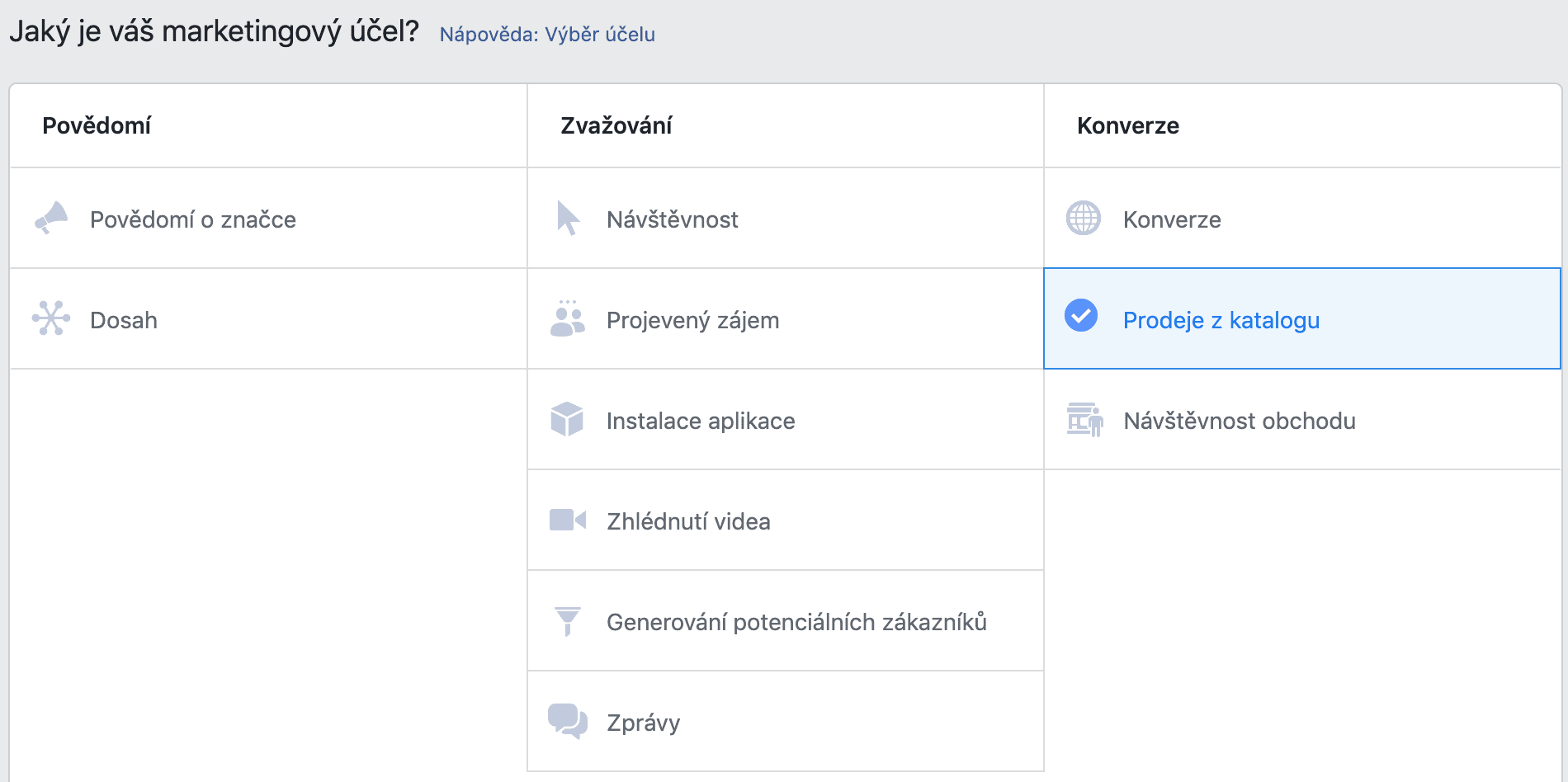
- Go to the Campaign Budget Optimization section and select "Minimum Target Return on Ad Spend (ROAS)" as your campaign bidding strategy.
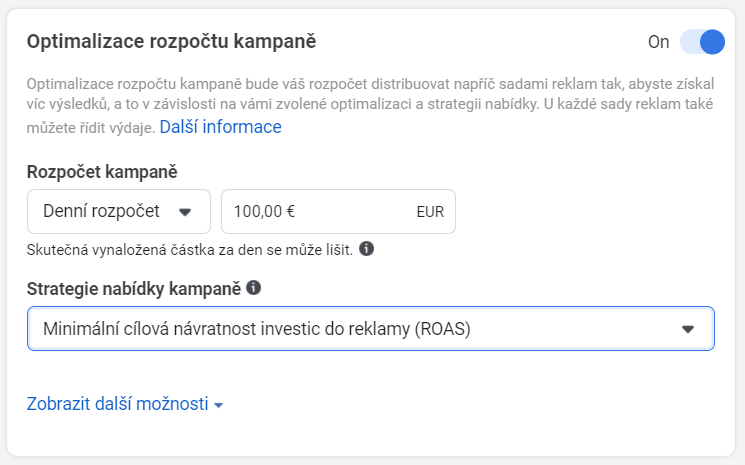
How to Calculate ROAS in Google Ads?
You can easily track the return on ad spend in Google Ads. How do you do it?
- Set the conversion values —to measure ROAS in Google Ads, you first need to set the conversion values in your campaigns. These values can be either the same (static) or different (dynamic) for all conversions, depending on what you choose.
For example, for an e-shop offering a wide range of products at different prices, we would recommend dynamic values. However, if all products were priced roughly the same, you can choose a static value—such as either the average of these prices or the lowest price. - Go to the reports and select the “Conversion Value / Price” column.
Just like Facebook, Google Ads allows you to directly select the Target Return on Ad Spend (ROAS) strategy in Ads Manager. You can find all the information about it in their Support Center. How do you set it up?
- Set the values for measured conversions.
- Change the strategy to “Target Return on Ad Spend (ROAS)” —in the selected campaign, go to Settings > Bidding and select this strategy. To use this strategy, your campaign must have had at least 20 conversions in the last 45 days.

How to Increase ROAS?
Are your return on ad spend (ROAS) figures very low? Or are they good, but you want them to be even better? To increase them, you can take the following steps: reduce ad costs, increase ad revenue, or do both. Read these 16 tips on how to achieve this:
- Choose the right campaign objective —that is, if you want to increase sales, you shouldn’t select an objective from the “Awareness” or “Consideration” options, but rather from the “Conversions” option.
- Check to make sure you’re actually measuring what you want —if a campaign is underperforming, ask yourself these questions:
- Did you choose the right attribution model? In some cases, it’s necessary to track what influences a customer to make a purchase on a slightly broader scale. In other words, don’t just track the final step (the purchase itself), but the entire journey of their purchasing decision. This will help you understand what influenced their decision.
- Do you segment large campaigns into smaller groups by category ( i.e., break a large campaign down into several smaller ones)? No? Give it a try. More specific campaigns focused on a single part of your product range lead to higher conversion rates. At the same time, this makes it easier to identify what’s not working, so you can optimize your ads more effectively.
- Improve your Quality Score— this is a Google metric that evaluates how relevant your ad is to your selected keywords.
General Tips
- Use smart bidding (automatic bidding) —as we’ve already mentioned, both Facebook and Google offer automated smart bidding strategies that optimize themselves. Both platforms let you select ROAS directly.
- Try out multiple ad formats —don’t limit yourself to just one type of ad.
- Facebook: In addition to banners, try images, videos, or flyers, for example.
- Google: In addition to PPC ads, try Google Shopping. Research by Adthena has shown that Google Shopping campaigns generate 85% more clicks than text ads. And that sounds great, don’t you think?
- Analyze your marketing campaigns to find out what really works —focus on what’s most effective for you!
- Facebook: Which ad placement on Facebook generates the most conversions for you? Is it the Facebook Feed, the Facebook Right Column, or perhaps Facebook Stories? From which devices do your customers shop most often?
- Google: Which types of ads generate the highest revenue for you? Are they PPC ads or Google Shopping? From which devices do your customers most often make purchases?
- Focus on the visual aspects of your ads —according to a PR Daily study, visual content gets 94% more views than text-only content without visuals.
- Reduce the time spent managing your campaign— try to manage your ads as efficiently as possible, and use various software tools that will save you time. If you manage the campaign yourself and it takes a lot of time (and money), consider outsourcing it—and vice versa.
- Choose the right keywords— targeting the wrong keywords wastes both time and money. If you replace inappropriate keywords with the right ones, your ads can generate much higher revenue, so reanalyze your keywords and change them if necessary.
Sometimes, all you need to do is add words related to the intent to buy—such as “buy,” “sale,” “cheap,” “clearance,” or “price”—to “short-tail” keywords. This change can lead to an increase in conversions for keywords that previously didn’t perform well. - Focus on the right target audience— for your ads to be effective, you need to understand your target audience and tailor your campaign to them.
- Don’t set your ROAS too high— it could cause a significant drop in conversions (clicks) or even lead to your campaign being paused.
- If you’re calculating ROAS yourself, be sure to include these costs in your calculation:
- vendor costs —fees and commissions you pay to your vendors and partners (including software fees, etc.)
- salaries of employees who worked on the project
- Use remarketing — target not only users who have already visited your site or completed a conversion, but also take advantage of Lookalike Audiences, which both Facebook and Google offer.
- Don’t forget to include a CTA (Call to Action) in your ad —this prompt helps encourage users to take the action you want. Create a sense of urgency so people will make a purchase from you right now.
- Optimize your landing pages —does your website load fast enough? Does it look convincing? Does it look good? Does it match what you’re advertising? If you answer “no” to any of these questions, fix it.
Work on your page design and give people what they expect and are looking for. If they’re redirected to a page that isn’t compelling, looks chaotic, or is unattractive, there’s a high probability that potential customers will leave it.
Also focus on whether the ad truly matches what your website offers. If you promise something in the ad that potential customers can’t find on your website, they’ll most likely leave without making a purchase, and you’ll just be paying for clicks unnecessarily.
And one last piece of advice?
- Test and track —that’s the only way to improve the effectiveness of your ad campaigns!
ROAS Limitations
Return on AdSpend (ROAS) also has its downsides:
- It doesn’t take into account campaign-related costs or other expenses— the formula only accounts for the direct costs paid for promotion. In other words, it doesn’t factor in the marketer’s salary, software, etc.
- The original formula uses revenue instead of profit —if profit were used, the resulting value could be much lower and, at the same time, more meaningful.
- The result can be misleading for the business as a whole —even if the resulting value is high, the company may still be operating at a loss, since manufacturing the product can be very costly.
- Not all forms of advertising can be easily evaluated— the effectiveness of some ads is difficult to determine. For example, it is hard to determine how many people purchased a product after seeing a roadside billboard. In this case, calculating ROAS will be challenging.